The Hidden Complexity of Moving Traffic
In major commercial centers, transit hubs, and high-rise infrastructure, the escalator is often the unsung hero of traffic management. Unlike elevators which move passengers in batches, escalators handle a continuous flow, making their uptime critical to building performance.
However, beneath the polished steps and smooth handrails lies a complex beast of mechanical engineering—a massive conveyor system moving tonnes of steel and humanity simultaneously. When these systems fail, or when a new installation is botched, the resulting chaos, liability, and financial loss are immediate.
This guide delves into the intricate world of installing and repairing these heavy-duty machines, specifically focusing on the nuances required to manage a diverse portfolio of major global brands.
Section 1: The Landscape of Major Escalator Brands
While the fundamental principle of an escalator (a moving staircase on an endless loop track) remains constant, the execution varies significantly between manufacturers. A "one-size-fits-all" approach to installation or repair is a recipe for disaster. An expert technician must understand the operational DNA of each major player.
The Big Players: A Technical Overview
Different manufacturers prioritize different aspects of design, from heavy-duty transit durability to aesthetic sleekness for luxury retail.
Brand Focus | Key Characteristics & Typical Applications | Common Technical Nuances |
Otis | Historical robustness; massive install base globally. Known for durability in standard commercial settings. | Often utilizes very traditional, heavy-duty drive chain configurations. Legacy controllers are widespread and require specific knowledge. |
Schindler | Market leaders in high-traffic solutions (airports, metros). Focus on transit-grade durability and modularity. | Advanced microprocessor controls; unique step chain designs aimed at reducing lubrication needs in newer models. |
KONE | Pioneers of "Eco-efficiency" and gearless drive technology. Strong focus on compact footprints. | Often utilize planetary gear drives or permanent magnet motors located inside the truss to save space, changing access points for repair. |
TK Elevator (formerly Thyssenkrupp) | Highly versatile; strong presence in heavy-duty infrastructure and innovative custom designs. | Known for robust truss structures. Their high-rise units often feature complex multi-drive systems that require synchronized calibration. |
Mitsubishi Electric | Precision engineering and ultra-smooth operation. Famous for specialized designs like spiral escalators. | extremely tight tolerances in manufacturing require equally precise installation leveling. Proprietary control logic is common. |
Hitachi | Strong focus on safety innovations, energy saving, and compactness, particularly in the Asian market. | Advanced sensor arrays for passenger detection and speed modulation require specialized diagnostic tools. |
Section 2: The Art & Science of Escalator Installation
Installing a new escalator is less about "plug-and-play" and more about heavy construction integration. It is a high-stakes phase where mistakes become permanent, expensive legacy problems.
Phase 1: Pre-Installation & Site Readiness
70% of installation issues stem from poor site preparation. Before the equipment arrives, the following must be certified:
The Wellway (Pit) and Support Beams: The building structure must be able to support not just the dead weight of the escalator (often 8–15 tonnes), but the "live load" of fully loaded passengers.
Clearances: Overhead clearance (headroom) and side clearances must meet strict local safety codes (e.g., EN 115 or ASME A17.1) to prevent rider injury.
Power Supply: A dedicated, stable three-phase power supply must be ready at the upper machine room location.
Phase 2: The Heavy Lift and Truss Placement
The escalator arrives either fully assembled (for shorter units) or in modular sections (for high-rise units).
Rigging and Hoisting: Using massive cranes to lower the escalator truss into the building void is the most dangerous phase. The truss must land perfectly on its isolation pads on the building beams.
Leveling and Alignment: This is critical. The truss must be perfectly level horizontally and aligned vertically. Brand Nuance: A Mitsubishi unit often requires tighter leveling tolerances than a standard commercial unit to ensure its signature smooth ride.
Phase 3: Mechanical Assembly and Running Gear
Once the skeleton (truss) is set, the moving parts are installed or connected:
The Track System: The guide rails for the step chain and the step rollers must be aligned with laser precision. Misalignment causes a "jerky" ride and premature wheel wear.
The Drive Machine: Connecting the main motor and gear reducer to the main drive shaft via heavy-duty duplex or triplex chains.
Handrail Drive Sync: The handrail must move at the exact same speed as the steps. If it is faster or slower, passengers lose their balance. Calibrating the handrail drive sheaves is a vital safety step.
Section 3: The Reality of Escalator Repair & Troubleshooting
Unlike elevators which often "fail safe" and stop, a deteriorating escalator gives warnings before catastrophic failure. Effective repair lies in recognizing these symptoms.
Common Failure Points and Diagnostic Approaches
The escalator environment is harsh—dust, grit, spilled drinks, and constant impact loading.
1. Step and Chain Issues (The Skeleton)
The step chain is the spine of the escalator.
Symptoms: Loud clunking noises at the turnarounds (comb plates), visible "stretching" of the steps, jerky motion.
Repair Reality: Chains stretch over time. Initially, tensioners can be adjusted. Eventually, the entire chain needs replacement—a massive job requiring the removal of all steps. Brand Nuance: Schindler's synthetic step rollers wear differently than Otis's traditional steel rollers.
2. The Comb-Step Impact (The Critical Safety Zone)
The point where the moving step meets the stationary floor plate (the comb) is the highest risk area for entrapment.
The Mechanism: If a foreign object (like a sneaker) gets wedged between the step and the comb, a safety switch must instantly cut power.
Repair Focus: These switches are notoriously sensitive. Technicians must frequently calibrate the gap between the teeth and the steps (usually 3-4mm) and test the impact sensor switches.
3. Handrail Systems
Symptoms: Slipping handrails, cracked rubber, overheating handrail drive motors.
Repair Reality: Replacing a vulcanized rubber handrail is physically demanding. Slippage is usually caused by insufficient tension in the newel drive wheel or contamination on the traction surface.
4. Controller and Sensor Faults
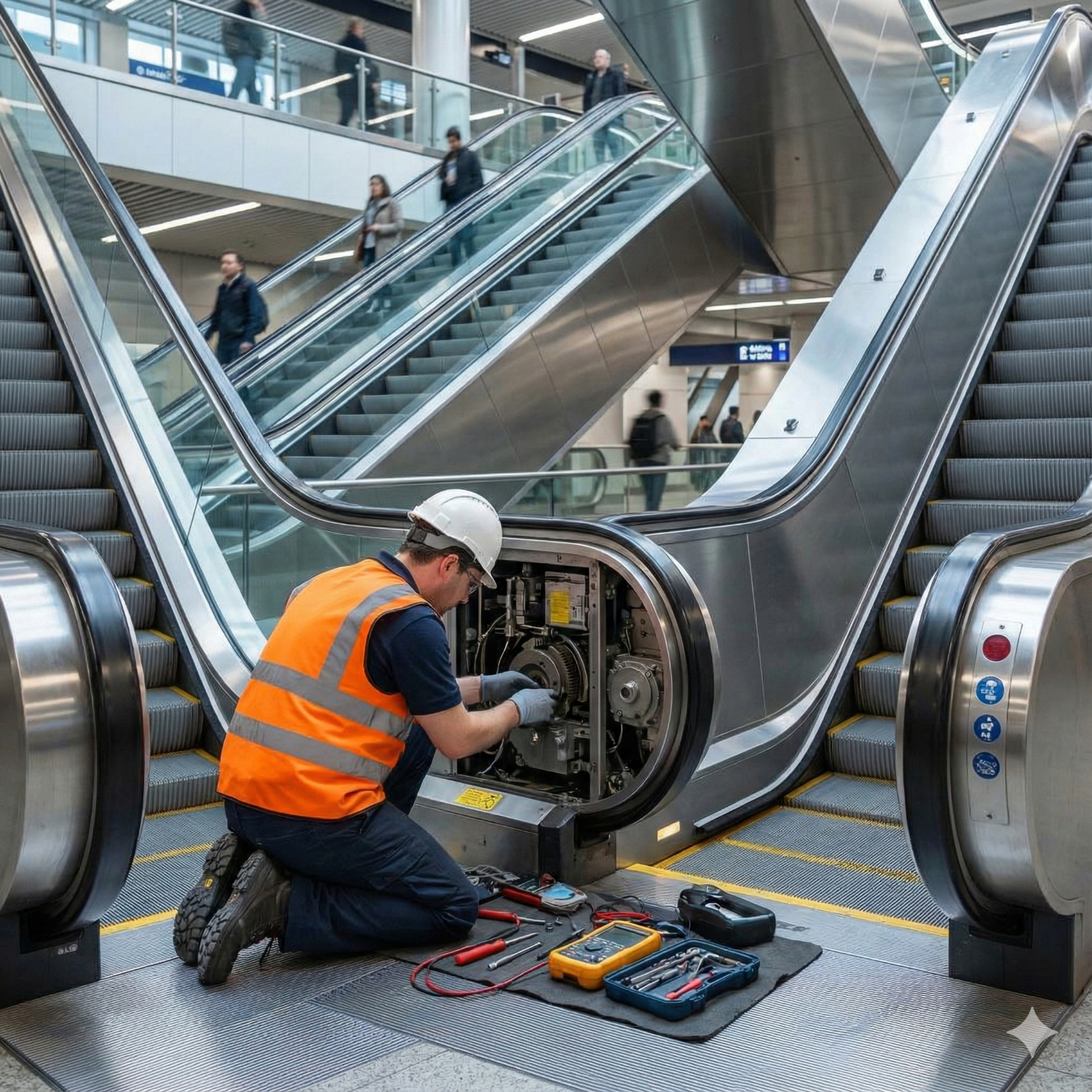
Modern escalators (KONE, newer TK) are computer-controlled with dozens of safety sensors.
Symptoms: Random stoppages with obscure error codes on the PCB board.
Repair Reality: This requires brand-specific diagnostic tools (laptops with proprietary software) to read the fault history. A generic technician cannot easily troubleshoot a locked-down Mitsubishi controller without the right interface key.
Section 4: The Argument for Specialized, Multi-Brand Expertise
Building owners often face a dilemma: use the Original Equipment Manufacturer (OEM) for service or a third-party specialist.
While OEMs know their product best, they can be expensive and slow to service older models. A competent, specialized independent service provider offers a distinct advantage if they possess genuine multi-brand expertise.
The Toolbox of the Multi-Brand Technician
To effectively repair a mixed portfolio of Otis, Schindler, and Hitachi units, a service team needs:
Supply Chain Agility: Access to OEM spare parts and high-quality approved aftermarket alternatives when OEM parts are obsolete or backordered.
Legacy Knowledge: Understanding 30-year-old relay logic controllers (common in older Otis units) just as well as modern microprocessor VVF drives (common in new KONE units).
Specialized Tooling: Having the specific chain breaking tools, handrail vulcanizers, and diagnostic software interfaces for each brand.
Conclusion: Managing the Lifecycle
An escalator is a 25-to-30-year investment. The quality of the initial installation dictates the first 10 years of its life. The quality of the repair and maintenance dictates the rest. Whether managing a sleek Mitsubishi spiral escalator in a luxury mall or a rugged Schindler transit unit in a subway, understanding the mechanical realities and brand-specific nuances is the only way to ensure safe, continuous vertical mobility.